
Rs. 0.00


MRP (Inclusive of taxes)
MRP ₹ (Incl. of all taxes)
Couldn't load pickup availability
Product Description
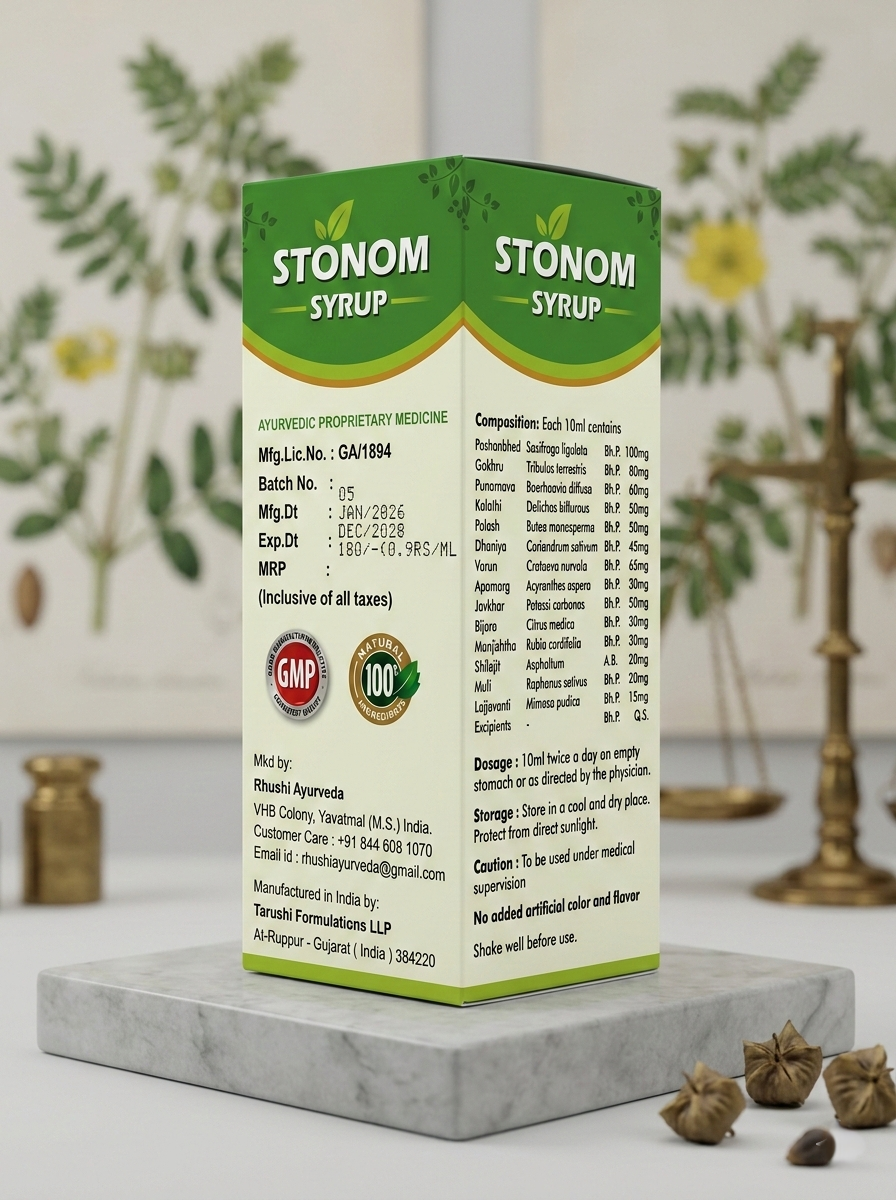
Stonom Syrup by Rhushi Ayurveda is a carefully formulated Ayurvedic proprietary medicine designed to support kidney health and the overall renal system. Enriched with time-tested herbs like Pashanbhed, Gokhru, Punarnava, and Varun, this natural formulation helps maintain urinary tract health and supports the body's natural detoxification process.
Crafted with 100% natural ingredients and manufactured under GMP-certified practices, Stonom Syrup is designed to offer gentle yet effective kidney care support without added artificial colors or flavors.
A trusted Ayurvedic blend for those seeking natural renal wellness support.
Ingredients
Pashanbhed (Saxifraga ligulata)
Gokhru (Tribulus terrestris)
Punarnava (Boerhavia diffusa)
Varun (Crataeva nurvala)
Kalathi (Dolichos biflorus)
Palash (Butea monosperma)
Dhaniya (Coriandrum sativum)
Dosage
10 ml twice daily on an empty stomach
Or as directed by the physician
Shake well before use
Key Benefits
Supports overall kidney health
Helps maintain healthy urinary function
Assists in natural detoxification of the renal system
Supports urinary tract comfort
Helps maintain fluid balance in the body
Made with 100% natural ingredients
No added artificial color or flavor
GMP certified manufacturing
Frequently Asked Question
Q1. What size of kidney stone can Stonom Syrup realistically dissolve — does it work on large stones too?
ANS: Ayurvedic formulations like Stonom are most effective for small to medium stones (generally up to 6–8mm) that are non-obstructive, where the herbs can gradually break down crystal formations and assist passage through improved urine flow. Stones larger than 8–10mm, or those causing urinary blockage, require urological intervention — Stonom should be used as a supportive measure, not a replacement for surgery or lithotripsy in such cases.
Q2. Does Stonom Syrup work differently for different types of kidney stones — oxalate vs uric acid vs calcium phosphate?
ANS: This is an underasked question — the effectiveness varies by stone type. Varun and Pashanbhed are particularly effective against calcium oxalate stones (the most common, accounting for over 80% of cases) by inhibiting oxalate crystallisation, while Gokhru's diuretic action helps flush uric acid stones; knowing your stone type from a lab report helps set realistic expectations.
Q3. Can I take Stonom Syrup if my creatinine levels are already elevated?
ANS: This is critical — Punarnava and Gokhru are diuretic herbs that increase renal workload, which could theoretically stress kidneys that are already functioning poorly with elevated creatinine. Patients with creatinine above 1.5 mg/dL or any diagnosed CKD (Chronic Kidney Disease) must consult a nephrologist before starting Stonom, as herbal diuretics can worsen kidney function in compromised kidneys.
Q4. How much water should I drink alongside Stonom Syrup — does it matter?
ANS: Water intake is not just important — it is the most critical co-factor for any kidney stone treatment to work. The herbs in Stonom create the conditions for stone dissolution and passage, but adequate hydration (at least 2.5–3 litres of water daily) is what physically flushes the fragments out; without this, the syrup's effectiveness is significantly diminished.
Q5. Can Stonom Syrup be used during a painful acute kidney stone attack, or only as a preventive?
ANS: Stonom can provide anti-inflammatory and antispasmodic relief during an active attack through Varun and Dhaniya's properties, but severe renal colic with intense pain, fever, or vomiting requires urgent medical evaluation first. The syrup works best as ongoing therapy — both during recovery after acute management and preventively between episodes.
Q6. Is Stonom safe during pregnancy — kidney stones are surprisingly common in pregnant women?
ANS: Gokhru and Varun have uterine-stimulating potential and should not be used during pregnancy without explicit approval from an obstetrician. Pregnant women experiencing urinary issues should prioritise safe hydration and medical guidance rather than herbal diuretics.
Q7. Can Stonom Syrup also help with UTIs, or is it only for kidney stones?
ANS: Yes — several ingredients in Stonom, including Palash, Dhaniya (Coriander), and Punarnava, have documented antimicrobial and anti-inflammatory properties that address lower urinary tract infection symptoms like burning, frequency, and cloudiness. In fact, Stonom's urinary tract support makes it useful for UTI prevention in people prone to recurrent infections associated with kidney stones.
Q8. How long does a course of Stonom Syrup typically need to last before results are seen?
ANS: Symptomatic relief — less burning sensation, improved urine flow, reduced discomfort — is typically noticeable within 1–3 weeks. Stone dissolution or confirmed passage, verified by follow-up ultrasound, generally takes 4–12 weeks depending on stone size and composition.
Q9. Can Stonom Syrup be taken alongside allopathic medications like Tamsulosin (used to help pass stones)?
ANS: Stonom's herbal diuretic and anti-inflammatory action is generally compatible with and complementary to Tamsulosin (an alpha-blocker used to relax the ureter). However, since both may lower blood pressure as a secondary effect, patients on antihypertensives should inform their doctor to avoid compounding the effect.
Q10. Once my stone has passed, should I stop Stonom or continue to prevent recurrence?
ANS: This is exactly the right question — stopping treatment entirely after a stone passes is a common mistake, as the underlying urinary chemistry that caused the stone remains unchanged. A preventive maintenance course of Stonom for 4–6 weeks post-passage, combined with dietary changes (reducing oxalate-rich foods, increasing hydration), significantly reduces the risk of new stone formation.



© 2025, Rhushi Ayurveda
Powered by Logam Digital